Language:





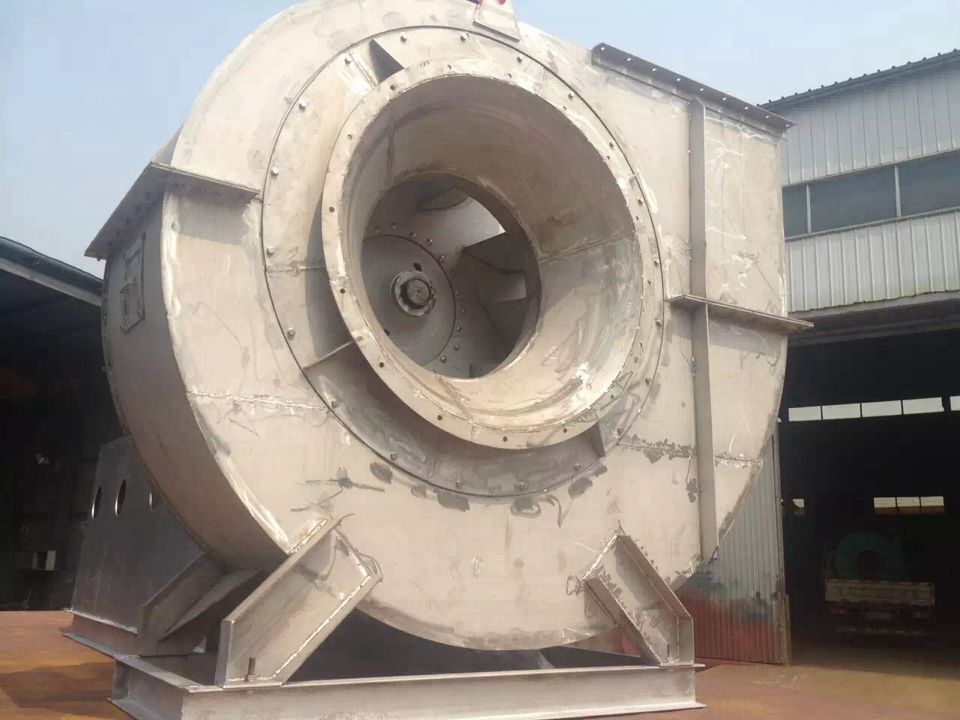
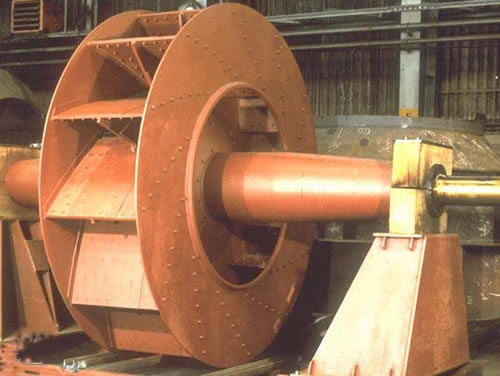
500 C marks the boundary between carbon steel and heat resistant steel. The impeller and casing move to 16Mng or 15CrMo, the coating becomes an inorganic zinc silicate system, and low temperature dew point corrosion has to be addressed in the same design.
Creep resistance replaces simple strength as the governing property at this level.
| Location | Material / process | Basis |
| Impeller and casing | 16Mng or 15CrMo (GB/T 713, GB/T 5310) | Better creep resistance than carbon steel |
| Surface treatment | Inorganic zinc silicate primer with heat resistant topcoat | Handles heat and flue gas attack together |
| Bearing assembly | Insulated housing with extended shaft | Reduces the temperature at the bearings |
| Insulation | 100 mm aluminium silicate fibre | Controls shell temperature and heat loss |
| Sealing | Labyrinth seal combined with graphite packing | Limits hot gas leakage |
| Location | Material / process | Basis |
| Thermal isolation of the drive | Insulating plate between housing and casing | Blocks radiation and conduction paths |
| Sliding feet | Fixed foot paired with a sliding foot | Releases axial growth at 500 C |
| Thicker welds at wear zones | Wider beads and added allowance | Combines hot strength with wear resistance |
| Dew point control | Operation kept above the acid dew point | Prevents low temperature corrosion |
| Expansion joints | Bellows joints in hot ducts (GB/T 12777) | Absorbs duct movement |
Applications include coal fired boiler flue gas, hot air furnaces, ceramic roller kilns and waste incineration heat recovery.
Boiler flue gas usually contains sulphur dioxide and moisture, so corrosion below the dew point must be considered together with temperature.
If the gas temperature stays below 150 C for long periods, dew point corrosion should be re-assessed and the material upgraded or the inlet air preheated.
| Standard | Title | Purpose |
| GB/T 713 | Steel plates for boilers and pressure vessels | Heat resistant plate acceptance |
| GB/T 1236 | Industrial fans - Performance testing using standardized airways | Air flow, pressure and efficiency testing |
| GB/T 12777 | General specification for metal bellows expansion joints | Expansion compensation for hot ducts and casing |
| GB/T 9239.1 / ISO 21940-11 | Mechanical vibration - Balance quality requirements for rigid rotors | Impeller balancing grade |
| JB/T 10563 | General purpose centrifugal fans - Technical specifications | General technical conditions and works acceptance |
Please provide sulphur content, moisture, medium temperature, dust load and air flow. Fan size and motor power are calculated for the actual duty.
Boiler and kiln flue gas contains sulphur dioxide and water vapour. Below the acid dew point sulphurous acid forms and corrosion accelerates sharply, so material and insulation must address temperature and dew point together.
Temperature and moisture content decide. Where creep risk dominates at higher temperature, 15CrMo is preferred; where flue gas corrosion dominates and temperature stays under 500 C, 16Mng with a coating is more economical.
Adding thickness changes the flow passage and the rotor mass, so air flow, pressure and balancing all have to be recalculated rather than substituted directly.
Related pages:
Contact: Lee
Phone: 13793313126
Tel: 0533-6820280
Email: chuanyi99@126.com
Add: Wujia Industrial Park, Nanjiao Town, Zhoucun District, Zibo City, Shandong Province, China