Language:



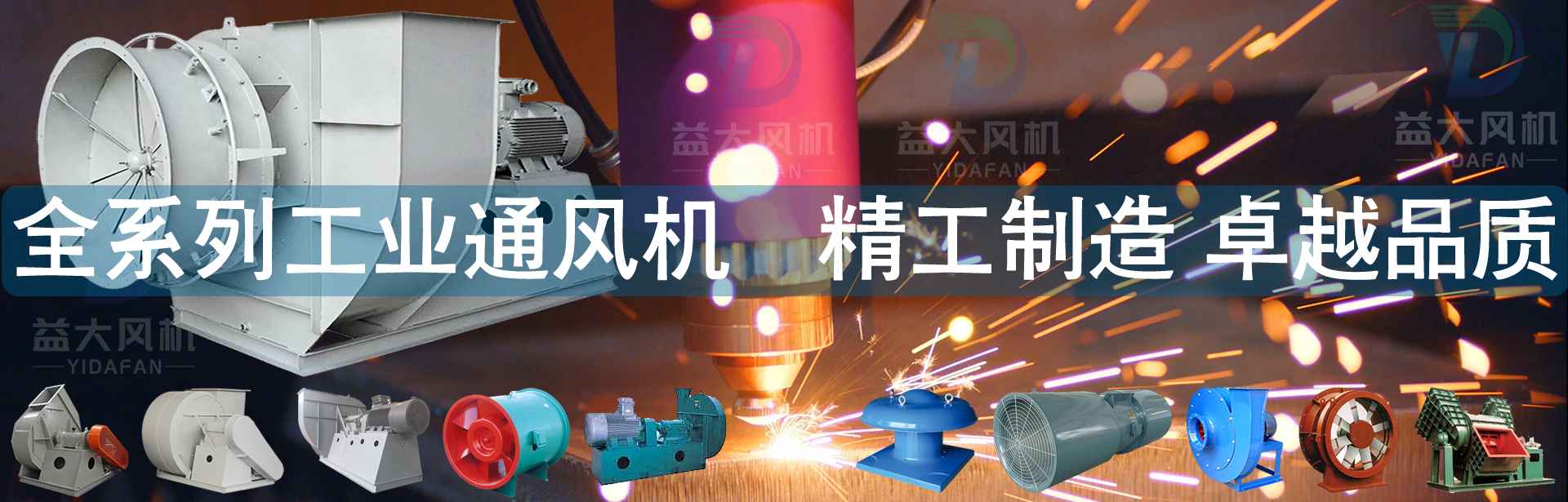

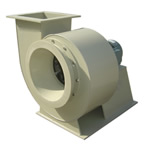
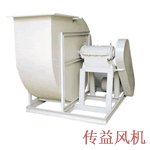
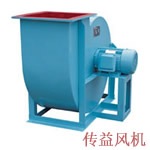
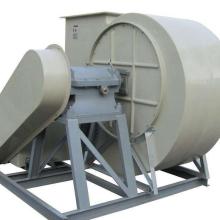
F4-62 corrosion resistant centrifugal fan for general corrosive gas.
A steel lining is not a single coating. The process chain runs from grit blasting to Sa2.5, adhesive application, sheet or hot pressing, vulcanisation (autoclave or ambient), spark testing, thickness measurement, to flange turn-up and weld treatment. A failure at any step shows up later as blistering, debonding or a local perforation.
The F4-62 handles general corrosive gas: plastic lining may use PP-lined or PE-lined, strongly corrosive sections use PTFE-lined, and rubber lining suits ambient solids bearing media.
| Lining type | Base and lining | Typical temperature | Media and process notes |
| Rubber lining | Steel + natural or butyl rubber | Usually up to 80 C | Dilute acids and abrasion; sheet applied after blasting, autoclave cured |
| Plastic lining | Steel + PP, PE or PVDF | Commonly 60 to 120 C | Acids, alkalis and salts; hot pressed or loose lined, flanged seal |
| PP-lined | Carbon steel + polypropylene | Commonly up to 100 C | Acids, alkalis and salts; sheet or roll lining, double welded seams |
| PE-lined | Carbon steel + polyethylene | Commonly 60 to 70 C | Abrasion and low temperature; ambient solids bearing media |
| PTFE-lined | Carbon steel + PTFE | Commonly -180 to 260 C | Strong acids, alkalis and oxidisers; isostatic or loose lining, flanged seal |
| Natural rubber lining | Carbon steel + natural rubber | Commonly up to 70 C | Dilute acids and solids; bond strength checked after cure |
| Butyl rubber lining | Carbon steel + butyl rubber | Commonly up to 90 C | Good gas tightness and weathering; suitable for gas bearing media |
Concentration, temperature, solids content and oxidising components should be written into the technical agreement. After lining, the fan is performance tested to GB/T 1236, balanced to GB/T 9239.1, and the lining is spark tested and thickness checked.
Contact: Lee
Phone: 13793313126
Tel: 0533-6820280
Email: chuanyi99@126.com
Add: Wujia Industrial Park, Nanjiao Town, Zhoucun District, Zibo City, Shandong Province, China