Language:




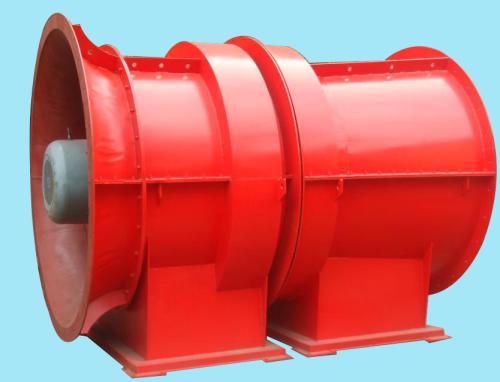
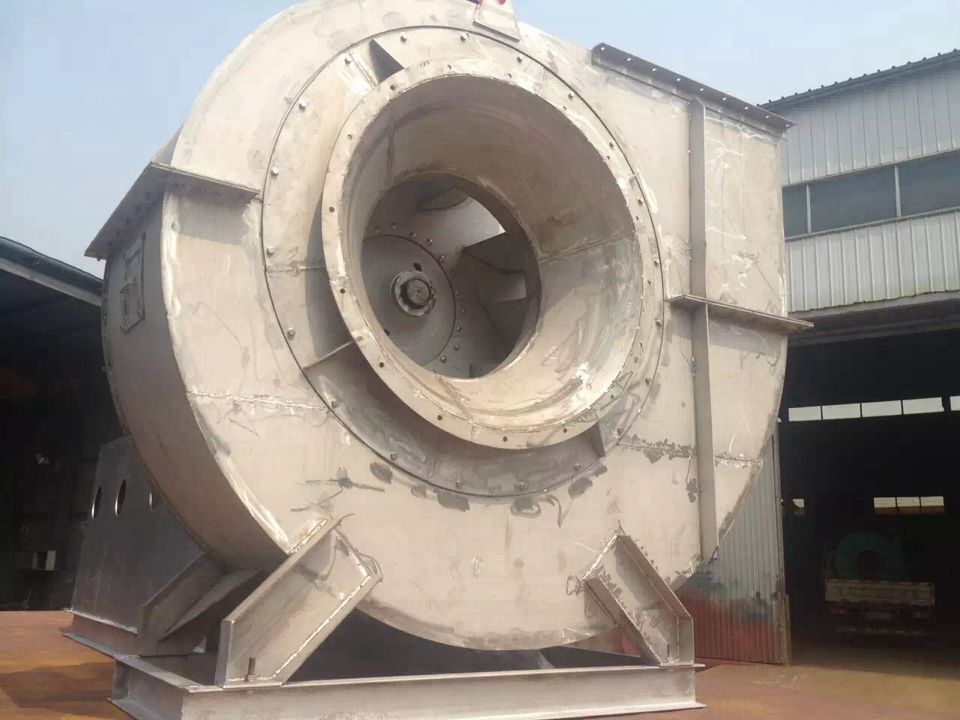
At 700 C the material has to move to austenitic stainless steel. Grade 304 or 321 protects itself with a dense oxide film and no longer depends on a coating, while a thermal sleeve on the shaft and water cooling on the bearing housing carry the heat load.
Austenitic stainless steels resist scaling far better than pearlitic grades at this temperature.
| Location | Material / process | Basis |
| Impeller and casing | 06Cr19Ni10 or 06Cr18Ni11Ti (GB/T 4237) | Better scaling resistance than pearlitic steel at 700 C |
| Welding consumables | Stainless electrodes (GB/T 983) | Matches strength and corrosion resistance |
| Bearing assembly | Water cooled housing with extended shaft | Isolates radiant heat |
| Insulation | Ceramic fibre lining with external insulation | Lowers wall temperature and heat loss |
| Fasteners | Heat resistant stainless steel | Prevents seizure from oxidation |
| Location | Material / process | Basis |
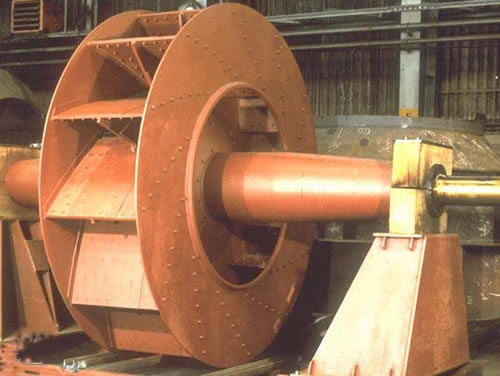
| All stainless impeller | Fabricated to a stainless welding procedure | Avoids dissimilar metal thermal stress |
| Thermal sleeve on the shaft | Insulation between impeller and bearing | Reduces heat flow to the bearings |
| Sliding guide support | One fixed and one sliding leg | Releases large thermal growth |
| Re-balancing after fabrication | G6.3 or tighter as required | Controls vibration at temperature |
| Internal lining anchors | Stainless anchors hold the fibre | Prevents lining collapse |
Applications include metallurgical reheat and annealing furnaces, forging furnace off gas and heat recovery boilers.
Austenitic stainless steel relies on a dense oxide film. Where the medium contains sulphur, the stability of that film has to be assessed.
Where the fan is started and stopped frequently, the heating rate should be controlled to avoid thermal shock cracking of the lining and impeller.
| Standard | Title | Purpose |
| GB/T 4237 | Hot rolled stainless steel plate, sheet and strip | Stainless impeller and casing material |
| GB/T 983 | Stainless steel covered electrodes | Weld strength and corrosion resistance |
| GB/T 1236 | Industrial fans - Performance testing using standardized airways | Air flow, pressure and efficiency testing |
| GB/T 9239.1 / ISO 21940-11 | Mechanical vibration - Balance quality requirements for rigid rotors | Impeller balancing grade |
| GB/T 3003 | Refractory fibres and products | High temperature lining material and acceptance |
Please provide gas composition, temperature, dust load and air flow. Fan size and motor power are calculated for the actual duty.
Grade 321 contains titanium, which gives better intergranular corrosion resistance and high temperature stability for continuous duty above 600 C. Grade 304 costs less and suits duties where temperature fluctuates little. Neither is suitable for high sulphur gas.
It has to be assessed. Stainless steel corrodes in chloride bearing or reducing sulphur atmospheres, and such duties call for 316L, duplex grades or an internal lining.
Life depends on dust load, temperature fluctuation and the number of starts. Wall thickness measurement and vibration monitoring give a better replacement interval than a fixed service life.
Related pages:
Contact: Lee
Phone: 13793313126
Tel: 0533-6820280
Email: chuanyi99@126.com
Add: Wujia Industrial Park, Nanjiao Town, Zhoucun District, Zibo City, Shandong Province, China