Language:




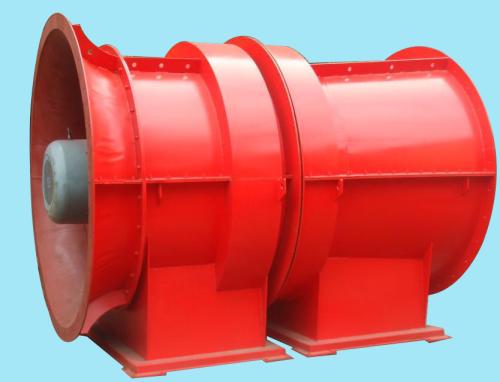

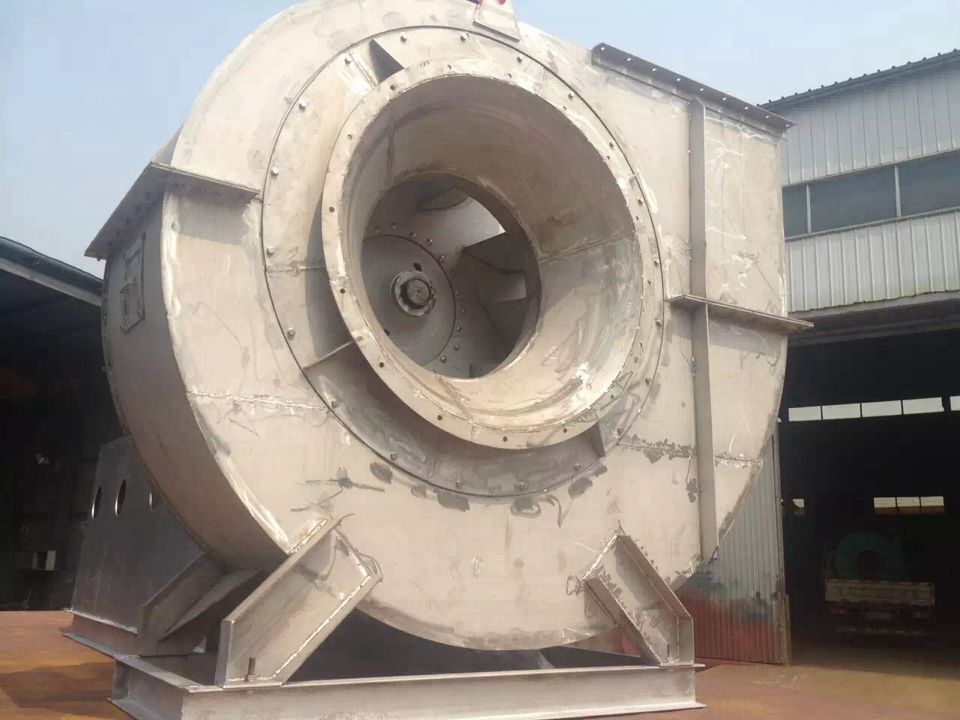
800 C calls for grade 310S. Its 25 percent chromium and 20 percent nickel form a stable oxide film in strongly oxidising gas, and a ceramic fibre lining behind the casing keeps the metal wall temperature down. Lining anchors and expansion joints decide whether the lining survives.
High chromium and nickel content is what makes 310S suitable for strongly oxidising gas at this level.
| Location | Material / process | Basis |
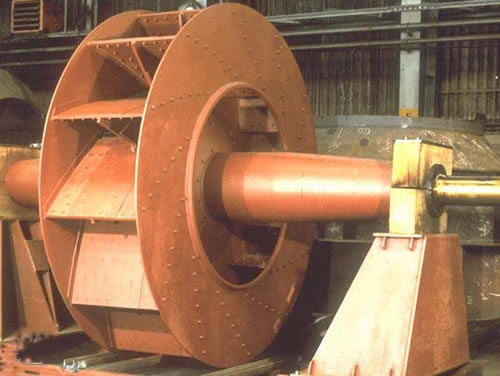
| Impeller and casing | 06Cr25Ni20 (GB/T 4237, GB/T 20878) | Good scaling and creep resistance at 800 C |
| Welding consumables | Heat resistant stainless filler (ER310 type) | Prevents high temperature cracking |
| Bearing assembly | Water cooled housing with forced circulation | Maintains bearing temperature |
| Insulation | 80 mm ceramic fibre with anchors | Lowers wall temperature and heat loss |
| Expansion joints | Bellows joints (GB/T 12777) | Absorbs duct and casing movement |
| Location | Material / process | Basis |
| Anchored lining | Stainless anchors secure the ceramic fibre | Prevents lining from blocking the flow path |
| Expansion joints in the lining | Divided according to thermal growth | Stops the lining cracking on heat up |
| Sliding supports | Guided sliding structure | Releases large casing expansion |
| Weld inspection | Penetrant testing on critical welds | Finds crack initiation sites |
| Bake-out procedure | Controlled heating curve to remove moisture | Protects the lining on first start |
Applications include sintering machine gas, roasting furnaces, glass furnace off gas and metallurgical cooling circuits.
This temperature band usually involves strongly oxidising gas, which is what the 25 percent chromium and 20 percent nickel content of 310S is designed for.
Where the duty involves frequent starting and stopping, the moisture removal schedule for the lining should be written into the operating procedure.
| Standard | Title | Purpose |
| GB/T 4237 | Hot rolled stainless steel plate, sheet and strip | Stainless impeller and casing material |
| GB/T 20878 | Stainless and heat-resisting steels - Designation and chemical composition | High temperature and corrosion resistant grades |
| GB/T 3003 | Refractory fibres and products | High temperature lining material and acceptance |
| GB/T 1236 | Industrial fans - Performance testing using standardized airways | Air flow, pressure and efficiency testing |
| GB/T 12777 | General specification for metal bellows expansion joints | Expansion compensation for hot ducts and casing |
Please provide gas composition, temperature, dust load and air flow. Fan size and motor power are calculated for the actual duty.
Both are used above 800 C. 310S relies on high nickel and chromium for scaling resistance, while 253MA adds silicon, rare earths and nitrogen for better creep and thermal fatigue performance at higher cost.
Under high velocity dust laden flow it can detach. Stainless anchors are used to hold the fibre, an anti-erosion layer is added at bends and castable material may be used where impact is severe.
Steel grows considerably between ambient temperature and 800 C. Without expansion joints the lining cracks on the first heat up and the crack grows with each cycle.
Related pages:
Contact: Lee
Phone: 13793313126
Tel: 0533-6820280
Email: chuanyi99@126.com
Add: Wujia Industrial Park, Nanjiao Town, Zhoucun District, Zibo City, Shandong Province, China