Language:




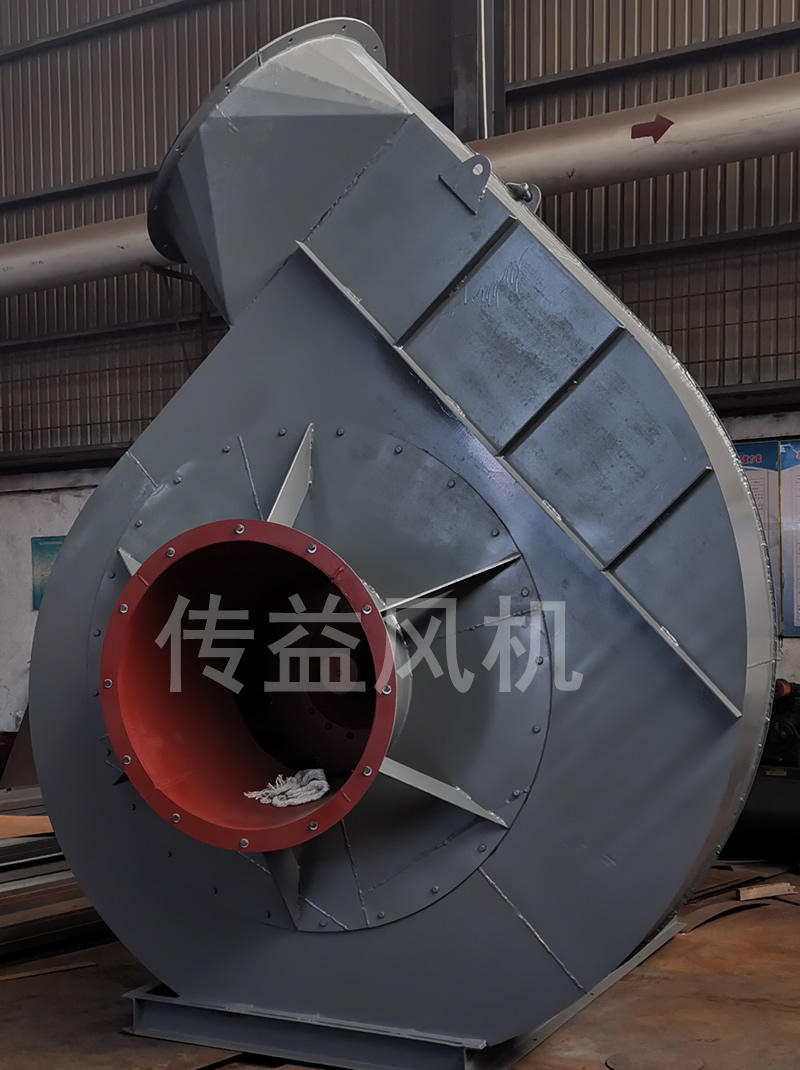
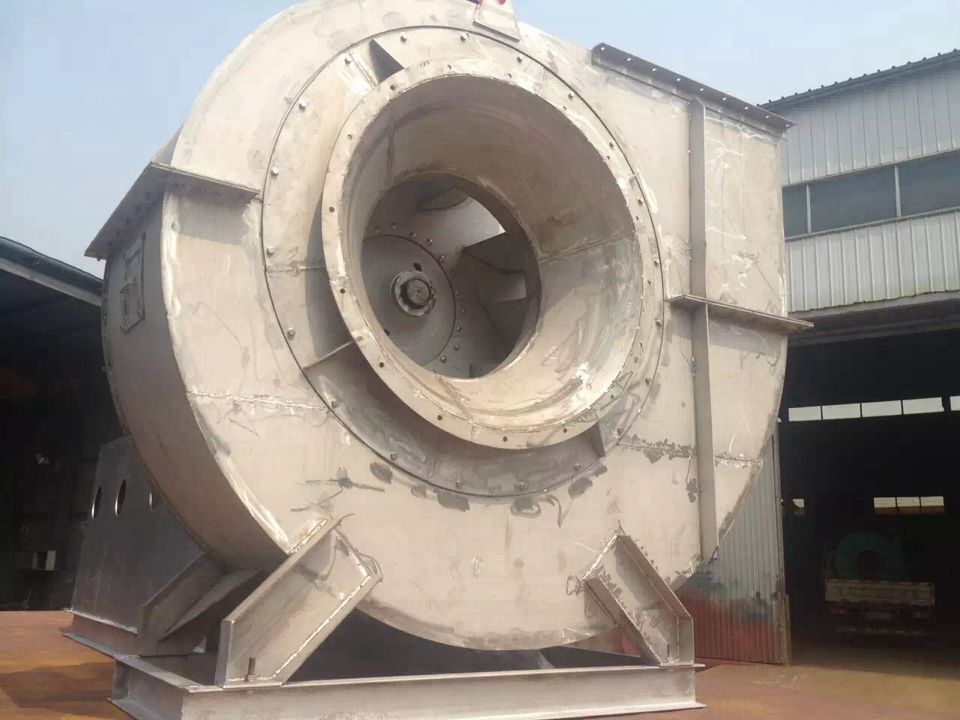
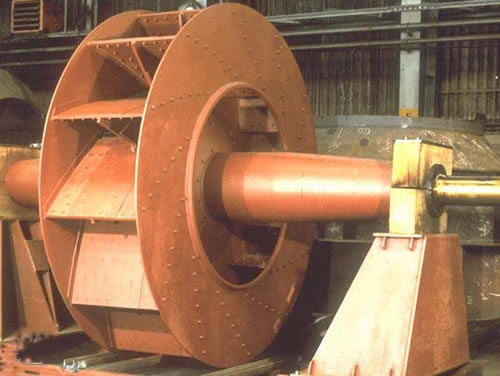
1000 C is the limit of conventional centrifugal induced draft fans and is a custom design. Impellers are usually cast in heat resistant steel ZG40Cr25Ni20, casing internals use 253MA or Inconel 601, and the lining reaches 150 mm of composite insulation with divided expansion joints, monitored by multiple thermocouples.
This band exceeds the long term limit of conventional austenitic grades, so each element is selected for its own duty.
| Location | Material / process | Basis |
| Impeller | Heat resistant cast steel ZG40Cr25Ni20 (HK40 type) or 253MA | Casting allows complex blade shapes with creep resistance |
| Casing and internals | 253MA, Inconel 601 (UNS N06601) | Good scaling resistance at 1000 C |
| Surface treatment | Anti-oxidation coating with pre-oxidation | Extends the replacement interval |
| Bearing assembly | Water cooled housing, oil circulation unit, thermal sleeve | Multi-stage isolation of the heat source |
| Instrumentation | Thermocouples with alarm and interlock | Detects over-temperature and lining damage |
| Location | Material / process | Basis |
| Composite lining | 150 mm composite insulation with divided expansion joints | Keeps the metal wall within its limit |
| Local water cooling | Bearing housing and local cooling panels | Handles intense radiant heat |
| Shaft thermal isolation | Sleeve with air or water cooling passage | Reduces the temperature gradient |
| Multi-point temperature monitoring | Thermocouples wired to alarm and interlock | Early detection of hot spots |
| Start-up curve | Controlled heating and cooling rates | Protects lining and impeller on start |
Applications include yellow phosphorus tail gas, hazardous waste incineration, special kilns and high temperature gas circulation test rigs.
This band is a custom design: material and structure are calculated from the actual gas composition, dust load and continuous operating hours.
Because the duty is outside standard product ranges, the technical agreement should define the heating and cooling curves, the allowable wall temperature limit and the inspection window.
| Standard | Title | Purpose |
| GB/T 20878 | Stainless and heat-resisting steels - Designation and chemical composition | High temperature and corrosion resistant grades |
| GB/T 3003 | Refractory fibres and products | High temperature lining material and acceptance |
| GB/T 12777 | General specification for metal bellows expansion joints | Expansion compensation for hot ducts and casing |
| GB/T 9239.1 / ISO 21940-11 | Mechanical vibration - Balance quality requirements for rigid rotors | Impeller balancing grade |
| JB/T 10563 | General purpose centrifugal fans - Technical specifications | General technical conditions and works acceptance |
Please provide gas composition, temperature, dust load, continuous operating hours and air flow. The design is calculated for the actual duty.
This temperature exceeds the long term service range of conventional austenitic stainless steel. Material, lining, cooling and monitoring all have to be engineered for the specific duty, so a standard model cannot cover it.
Complex blade shapes favour cast ZG40Cr25Ni20; thin section and high accuracy blades favour a fabricated 253MA structure. Both require a creep assessment for the duty.
Not by a fixed period. Thermocouples and infrared measurement track wall temperature in service, while lining and impeller thickness are measured during shutdowns, and the interval is adjusted from the measured data.
Related pages:
Contact: Lee
Phone: 13793313126
Tel: 0533-6820280
Email: chuanyi99@126.com
Add: Wujia Industrial Park, Nanjiao Town, Zhoucun District, Zibo City, Shandong Province, China