Language:



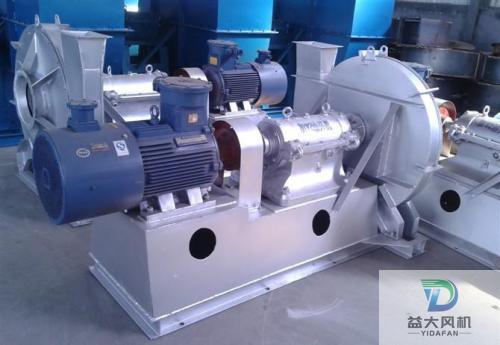
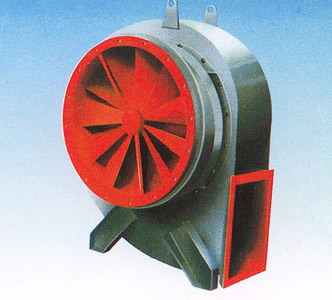
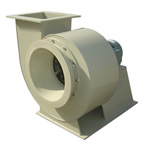
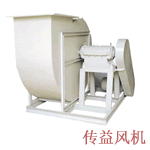
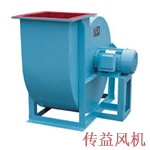
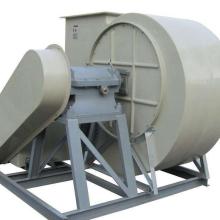
Hydrochloric acid is a non-oxidising acid carrying aggressive chloride ions, so material selection is tied to non-metallic solutions. Carbon steel and 316L both fail through chloride pitting, and a fan for this duty is built in PP, PVC, FRP or PVDF according to acid concentration and temperature.
The aggressiveness of hydrochloric acid varies strongly with concentration and temperature. Dilute acid is the more aggressive case, while chlorides remain a pitting risk even at higher concentration.
| Location | Material / process | Basis |
| Impeller | PP or PVDF moulded / welded impeller | Suits ambient to 60 C; PVDF covers higher temperature |
| Casing | FRP hand lay-up or welded PVC sheet | Easy to form in large and irregular shapes |
| Shaft | 316L sheathed in PP or PVDF, or titanium | Keeps metal out of contact with acid vapour |
| Sealing | PTFE lip seal or mechanical seal | Stops acid vapour escaping along the shaft |
| Metal parts | Epoxy or vinyl ester coating | Isolates bolts, base frame and fasteners |
| Location | Material / process | Basis |
| Welding procedure | Consumables and parameters qualified per material | Ensures weld strength and tightness |
| Weld inspection | Visual plus spark or penetrant testing | Locates leakage points |
| Fasteners | Polypropylene or sheathed 316L bolts | Prevents fasteners corroding first |
| Drain and wash | Drain and wash connections at the casing low point | Allows acid residue to be removed |
| Motor isolation | Corrosion resistant baffle between motor and casing | Protects motor insulation |
Applications include chemical reaction off gas, pickling tank exhaust, electroplating acid mist, hydrochloric acid tank breathing and laboratory ventilation.
Where chlorine or hypochlorous acid is also present, attack increases further and the material has to be re-assessed for the mixed medium.
Concentration and temperature should be mandatory entries in the technical agreement, and material allowance should be provided where concentration fluctuates.
| Standard | Title | Purpose |
| HG/T 20679 | Design code for external anti-corrosion of chemical equipment and piping | Anti-corrosion design for chemical media |
| GB/T 3854 | Barcol hardness test for reinforced plastics | Hardness acceptance of FRP parts |
| GB/T 1236 | Industrial fans - Performance testing using standardized airways | Air flow, pressure and efficiency testing |
| ISO 12944-5 | Paints and varnishes - Corrosion protection of steel structures by protective paint systems - Part 5 | Coating system and durability class |
| GB/T 9239.1 / ISO 21940-11 | Mechanical vibration - Balance quality requirements for rigid rotors | Impeller balancing grade |
Please provide acid concentration, medium temperature, dust load and air flow. Size and motor power are calculated for the actual duty.
Chloride ions break down the passive film of stainless steel and cause pitting and crevice corrosion, so 316L normally perforates quickly. Non-metallic materials such as PP, PVC, FRP and PVDF are used instead, or titanium and zirconium where a metal is required.
Below 60 C with mainly moulded parts, PP is more economical. For large casings, irregular shapes or higher stiffness, FRP hand lay-up is easier to form. The two are often combined.
Estimate from concentration, temperature and continuous running hours, then correct it during the first year using wall thickness and weld inspection. Impeller roots and welds deserve particular attention.
Related pages: Anti-corrosion fan range PP plastic fan Rubber and plastic lined fan
Contact: Lee
Phone: 13793313126
Tel: 0533-6820280
Email: chuanyi99@126.com
Add: Wujia Industrial Park, Nanjiao Town, Zhoucun District, Zibo City, Shandong Province, China